

Banks give you money to switch. That’s the premise. But the reason why, the catch, and whether the math actually works in your favour is worth understanding before you start redirecting your paycheque.
What’s actually driving the bonus
The chequing account isn’t the product. You are.
Before getting into the types of promos and how to evaluate them, it helps to understand what a bank is actually trying to accomplish when it hands you $500.
A chequing account on its own earns a bank very little. Monthly fees barely cover some operating costs, and deposits give the bank capital to lend out, but a basic chequing account customer generates close to zero individual profit. Retail banking research consistently finds that a small minority of customers, those who carry debt, pay interest, and hold multiple products, generate the overwhelming share of bank profits.
Cross-selling and your life-time value
What a welcome bonus actually buys the bank is a relationship. And the relationship is the start of a cross-sell pipeline, which basically means they will start selling you on other financial products that they offer.
So once you’re in, you’re a candidate for a credit card, a line of credit, a mortgage, and an investment account. Each product deepens the bank’s share of your financial life. The more products you hold, the less likely you are to leave, and the more profitable you become.
Banks model this out explicitly under a term known by business professionals called customer lifetime value. Welcome bonuses are factored in as a cost for acquiring you against their projected long-term profits.
Where the real profits for banks comes from
For Canada’s major banks, lending is the dominant revenue engine. Looking at CIBC’s publicly reported fiscal 2024 results as an example: net interest income, the spread the bank earns between what it charges on loans and what it pays on the deposits, came in at $13.7 billion. Total revenue was $25.6 billion. That means roughly 53% of CIBC’s revenue that year came from interest on debt. The pattern is consistent across the Big Six.
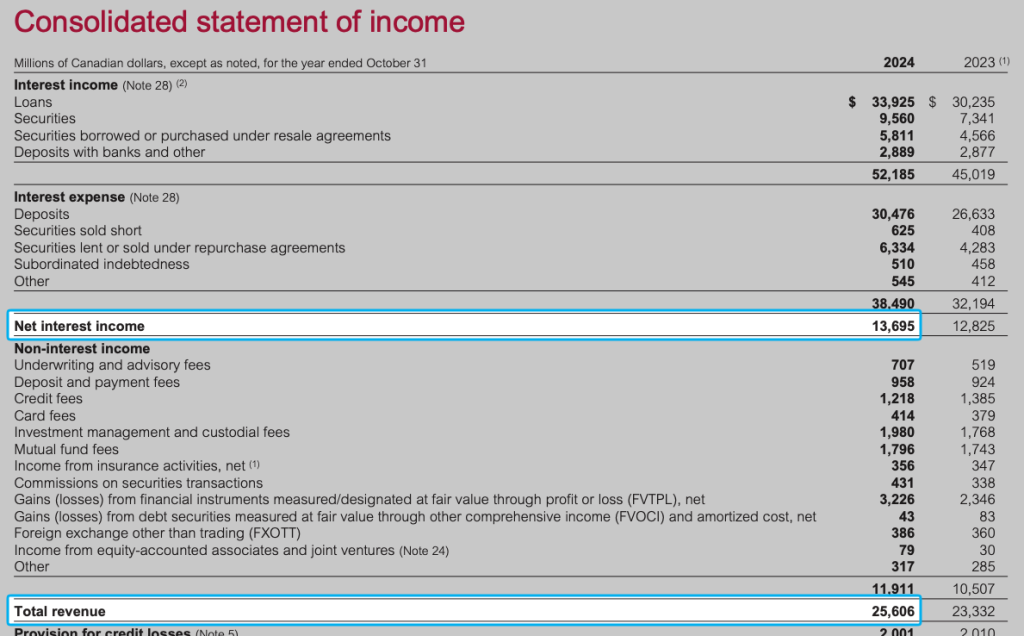
The chequing account with the $500 bonus is the door. The mortgage, the credit card carrying a balance, the line of credit, and don’t forget about insurances. These are where a bank makes its money back, and then some.
But this isn’t a critique of banks. It’s simply how the business works, and it’s publicly disclosed in every major Canadian bank’s annual report. This insight should sere as useful context when you’re thinking about what a welcome offer means to a bank’s business, because the bank has almost certainly done the math on what you’re worth to them over time before deciding what to offer you upfront.
Why banks offer welcome bonuses in the first place
It’s cheaper and sexier than a billboard
Banks treat welcome bonuses as a cost of business to acquire a customer like yourself. Instead of spending that money on advertising, they funnel it directly to the person they want to convert and bet that you’ll stick around long enough for them to earn it back.
Some good news for Canadians is that competition has made this more aggressive in recent years. Digital-first banks like Wealthsimple, EQ Bank, and Simplii Financial have put real pressure on the Big Six to work harder for new customers. A few hundred dollars used to be considered generous. Now it’s normal to see $500-plus cash bonuses, with some reaching $800 or more when you bundle products.
When promos are most competitive
Timing matters. Promos tend to be most aggressive during RRSP season in January and February, and again in the fall when students are opening first accounts. If you’re watching a specific bank and the current offer looks thin, waiting a few months is a reasonable strategy. Most banks refresh their promotions every two to four months.
Popular types of promos available to Canadians
Cash bonuses on chequing accounts
This is the most common type. You open a new account, complete qualifying actions within a set window, and the bank deposits your cash bonus after some time. The Big Six banks and digital players all run these regularly, and you can find more details from our best banks for Canadians guide.
A few things to know about how these are structured:
- No-fee accounts tend to offer smaller bonuses but often deliver better net value once you factor in the lack of monthly fees. Big banks are now waiving account fees if you take qualifying actions like doing direct deposits and set up pre-authorized bill payments.
- Premium accounts offer larger headline bonuses but usually carry fees of $17 to $30 per month. Though, again, these are waived with the same qualifying actions as everyone else.
- Banks like Scotiabank, TD, and BMO stack their bonuses across tiers, where additional amounts are unlocked by bundling with a savings account or a registered account like a TFSA or RRSP
Those bundled offers can look impressive on the headline but require more setup to actually unlock the full amount.
Promotional interest rates on savings accounts
Some banks compete on interest instead of cash. Across the different institutions, it tends to be a boosted rate for a fixed promotional period, typically three to six months, before dropping back to the standard ongoing rate that every customer receive.
- The gap between the promo rate and the standard rate is often large, so this type of promo is most useful for parking a specific sum temporarily. For example, a 4.5% promo rate vs. a 0.5% to 2% standard interest rate.
After the window closes, most Canadians will continue with the standard rate. That’s what the banks “bank” on.
Merchandise and non-cash rewards
Some banks have moved toward physical gifts. Tablets and wearable devices have both appeared as welcome offers for opening premium chequing accounts. Which you can wager target the broader and younger demographic with much of their financial life ahead of them.
These can look attractive at face value, but if the account carries a monthly fee and you have to hold it for a year or more to qualify, the net math can work against you.
Other promo types worth knowing about
- Referral bonuses: Most major banks run these. After you’ve joined, you can earn cash for each person you bring in who opens an account and completes the qualifying steps. Simplii, EQ Bank, BMO, and Tangerine have all run programs like this.
- Student and newcomer offers: Most major Canadian banks offer targeted promos for students and newcomers with more accessible qualifying requirements. Worth checking directly with the bank if either category applies to you.
New bank offer fine print: what’s the actual catch?
Almost no Canadian bank will hand you a bonus just for opening an account. You almost always have to complete qualifying actions and to keep your money with them long enough to receive your bonuses.
Timelines are strict and payouts are slow
Once you’ve met the conditions, the money doesn’t arrive immediately. Common things that catch people off guard:
- Payout timelines can range from a few weeks to several months after completing your qualifying actions. RRSP and TFSA promo interest rates tend to be tiered by duration and could take up to 5 years before you start receiving the full benefit of capitalizing on the promotion.
- Most banks require the account to remain open and in good standing at the time of payout.
- Closing early almost always forfeits the bonus entirely, which makes moving your money near-pointless.
Know your payout timeline before you start, and build it into your plan.
Monthly fees and the “new customer” trap
These two issues quietly reduce the value of more offers than people realise.
On fees
A $500 bonus on an account with a $30 monthly fee means you’re breaking even at roughly 16 months. If the fee isn’t waivable, the net value of the offer is significantly less than the advertised headline. Some accounts let you waive the fee by maintaining a minimum daily balance and making bill payments, which changes the math considerably.
On eligibility
Banks enforce the “new customer” definition more rigorously than people expect. RBC requires that you haven’t held a personal banking account with them in the prior five years. TD has disqualified customers who closed an account within the past year. If you’ve been a recent customer anywhere you’re considering, verify eligibility before investing time in an application.
How to tell if a promo is worth it
Run the math first
Start with the bonus, subtract any monthly fees you’ll pay while the account needs to stay open if you need to pay those, and what remains is your actual gain. A rough rule of thumb from the Canadian personal finance community: target at least $200 in net value before a promo is worth the administrative effort. The more steps required to earn it, the higher that threshold should be.
Ask yourself three practical questions
- Can you actually complete the qualifying actions? Rerouting payroll requires a form at work and at least one pay cycle to land correctly. A large deposit requirement means that cash can’t be tied up elsewhere.
- Does the account make sense after the promo ends? A savings rate that drops dramatically is a temporary parking spot, not a savings account. A genuinely useful no-fee chequing account is a different story.
- What are other Canadians saying about it? RedFlagDeals forums have active threads on most major bank promos and are a reliable way to find out whether the bank is paying out on time and whether there are conditions catching people off guard.
For tracking what’s currently available, sites like highinterestsavings.ca maintain regularly updated lists of active Canadian bank promotions.
What the experience is like after you sign up
The to-do list starts immediately
Once the account is open, the clock starts. Depending on the offer, you’ll need to:
- Redirect your direct deposit (expect at least one pay cycle of transition)
- Set up bill payments through the new account
- Configure pre-authorized debits to different billers (think: internet, home and auto insurances)
Keep track of your payout date and confirm with the bank that your qualifying actions are registered. Some banks send email confirmations when conditions are met. Others don’t, and you only find out there was an issue when the bonus doesn’t arrive. Banks are rolling out live chat and making it easier to get a human on a phone call, so that helps a lot.
What happens once the bonus lands
Once you’ve collected, you have a decision to make. If the account is genuinely useful, there’s no reason to close it. If it carries a monthly fee and no longer serves a purpose, closing it is reasonable. Just make sure outstanding payments and transfers have cleared first.
One thing to expect throughout: banks will actively try to cross-sell you. As covered at the top, this isn’t incidental. Credit cards, registered accounts, lines of credit, and eventually mortgages are part of what the bank modelled when it decided to offer you a bonus in the first place. That’s not a reason to avoid promos that are great for you, but it’s something to mind when you make the transfer.
How often should you switch banks?
The bank-churning approach
There’s a community of Canadians who treat bank promos the way others treat credit card sign-up bonuses, rotating deliberately through offers and moving on once the bonus lands. It works if you’re organised and comfortable with the overhead of changing where your money lives regularly.
The practical constraint is eligibility windows:
- RBC’s cooldown is five years
- TD’s is closer to one year
- Other banks fall somewhere in between
A disciplined person can cycle through several promos over two to three years without repeating.
The realistic cadence for most people
Whether bank-churning is worth it comes down to personality as much as finances. Rerouting direct deposits and reconfiguring pre-authorized payments is not complicated, but it adds up if you’re doing it constantly.
One or two high-value promos every two to three years is probably the right cadence for most people. And if you do it more frequently because you enjoy optimizing your bank accounts, financial products, and having conversations with bank employees, I am absolutely thrilled for you.
Beyond that, just be mindful of the time you spend and the energy that could go elsewhere. I myself question whether it’s worth it for me to do.
What else to look at before you commit
The welcome bonus should be the starting point of your evaluation, not the ending point.
Monthly fees and ATM access
A no-fee account is almost always a better long-term position than a high-bonus account with ongoing fees. Simplii Financial is a useful benchmark: a no-fee chequing account with no minimum balance requirement that stands on its own merits.
ATM access is worth checking if you use cash. Simplii gives you access to the CIBC network. Tangerine gives access to Scotiabank machines. EQ Bank has a prepaid card rather than a traditional debit setup. Know what you’re getting into before you commit.
CDIC coverage and deposit protection
CDIC deposit insurance covers eligible deposits up to $100,000 per insured category at member institutions. All of the major banks and most of the digital banks mentioned in this article are CDIC members, but it’s worth verifying for newer entrants.
Watch what happens to your credit limit
If you open a credit card as part of a banking bundle, or get offered one shortly after joining, be aware of how banks manage credit limits over time.
Canadian banks are required to obtain your consent before raising your credit limit, which is a meaningful protection compared to some other jurisdictions. But it’s worth understanding that banks use behavioural data to identify which customers are likely to carry a revolving balance if given more room, and they target limit increases accordingly. Research from King’s College London and the U.S. Federal Reserve found that roughly four in five credit limit increases in the U.S. are initiated by banks rather than requested by consumers, and that revolving balances tend to rise meaningfully after those increases.
In Canada, you have the right to say no. If you receive a credit limit increase offer and you don’t need the room, declining it is a reasonable call.
Customer service model and your other banking products
Digital-first banks mean phone and chat support only. No branch access if something complicated comes up. For most day-to-day banking this rarely matters, but it’s worth knowing.
If you’re planning to take on a mortgage within the next year or two, note that some banks offer bundled rate benefits when you hold multiple products with them. Opening a chequing account at your target mortgage institution ahead of time can sometimes improve your position when that conversation starts.
The Kyoufi bottom line
Welcome bonuses are real. Run the math, verify your eligibility, and track your payout date. Find an offer at an institution where the underlying account actually makes sense for how you bank, and the bonus becomes straightforward to collect.
If you miss a window, don’t stress. Most banks refresh their offers within a few months.
Leave a Reply